She had already decided. Almost.
The engagement ring sat in her cart — white gold, a single brilliant-cut diamond, exactly the one she’d been imagining for weeks. Her cursor hovered over the “Place Order” button. And then, at the final second, she stopped.
Nothing had gone wrong. The price was fair, the reviews were glowing, and the return policy was generous. Yet a quiet, wordless doubt held her hand still: I can’t hold it. She couldn’t feel the weight of the band, tilt it under the light, or see the diamond catch fire the way it would in person. So instead of buying, she closed the tab — promising herself she’d “think about it.” She never came back.
That hesitation is the single most expensive moment in online retail — the instant buyer confidence quietly collapses. And almost every store creates it without realizing.
The Gap You Can’t Photograph
Physical stores sell through the hands. A shopper picks up a ring, feels its heft, turns it, and slips it on. Touch does something no sign or salesperson can: it converts curiosity into certainty. Consumer researchers even have a name for this instinct — the “need for touch” — and for certain products, it drives the entire decision.
Online, that sense simply vanishes. Your customer will never hold your product before they pay for it. They can’t test the clasp, feel the fabric, or judge the true scale of a pendant. However good your photos look, a screen keeps the shopper at arm’s length. And in that gap between wanting and trusting, sales quietly disappear.
This is the trust gap at the heart of e-commerce. It’s invisible, it’s psychological, and it hits high-consideration products hardest of all — jewelry, watches, furniture, anything precious.
The Hesitation Has a Real Price
That wordless doubt isn’t harmless. Instead, it shows up in your analytics as abandoned carts, “I’ll think about it” exits, and a steady trickle of returns.
Consider returns alone. The National Retail Federation estimated that shoppers would send back roughly 19% of online purchases in 2025. Even more telling, Salsify’s consumer research found that 71% of shoppers have returned an item because it didn’t match what they saw online. Read that again: the product was fine — the understanding was wrong. The shopper simply couldn’t tell what they were really buying, so the parcel came back.
Every hesitation at checkout and every mismatched return traces to the same root cause: the customer couldn’t close the trust gap on their own. So the real job of a modern product page isn’t to show the product. Instead, it’s to let the shopper inspect it — as closely as their hands would, if only they could reach through the screen.
Build Buyer Confidence Without a Physical Store?
You build buyer confidence without a physical store by recreating in-person inspection with sight and motion — letting shoppers zoom in on fine detail, view products full-screen without distraction, and watch them move in video. Together, these tools replace the reassurance of touch, answer the questions a photo leaves open, and turn hesitation into a confident “Add to Cart.”
In other words, when customers can’t use their hands, you win them with their eyes. Here’s how the best product galleries do exactly that.
Letting Them Lean in: High-detail Zoom
Return to our ring buyer. Now imagine that instead of a flat, fixed photo, she could hover over the diamond and watch it magnify — close enough to study each facet, the prong setting, even the tiny hallmark stamped inside the band.
That’s what magnific zoom delivers: the digital equivalent of lifting an item to your eye. Detailed zoom recreates the single most important part of in-person inspection — the close look — and for products where craftsmanship is the value, it changes everything. A shopper who can examine the stitching on a leather bag or the engraving on a watch stops guessing and starts trusting. Suddenly the screen no longer holds them at arm’s length; instead, it invites them in.
The Full-screen Moment: An Immersive Lightbox
Zoom answers the detail question. A full-screen lightbox, meanwhile, answers a bigger one: what does this really look like, with nothing else in the way?
When our buyer clicks the ring and it expands into a clean, full-screen view — the menus, the sidebar, and the clutter all fading away — she finally sees it the way she would in a jeweler’s tray, under a spotlight, with her full attention. A full-screen product lightbox turns a small thumbnail into a showroom moment. It removes distraction, rewards curiosity, and lets shoppers swipe through every angle in one uninterrupted, immersive experience. And immersion, it turns out, feels a lot like confidence.
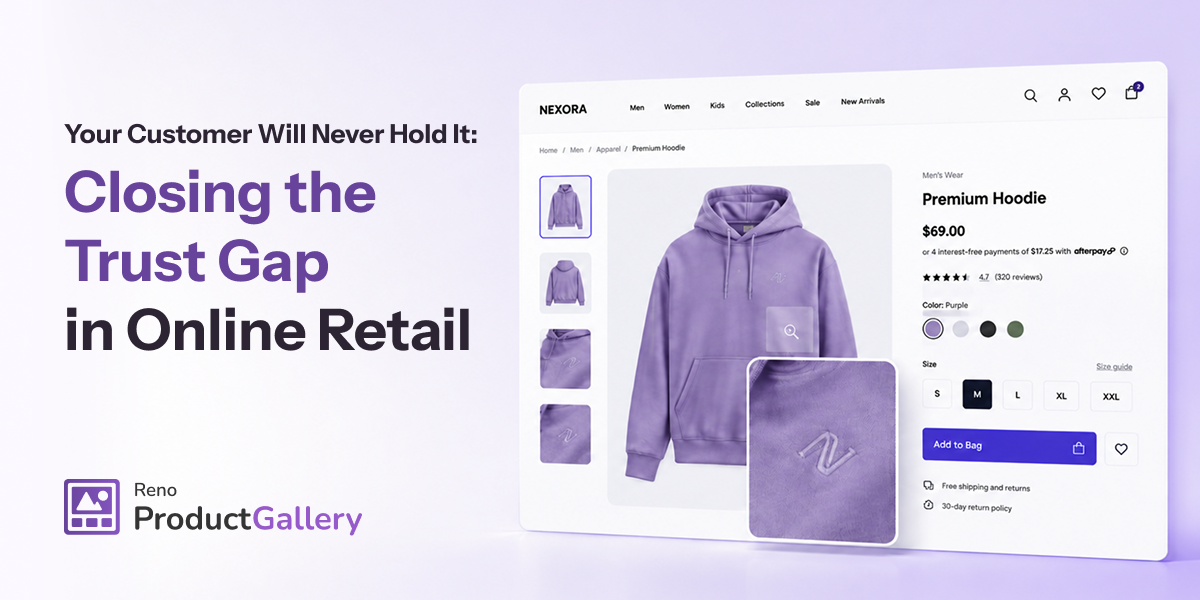
Want to give your shoppers that showroom moment? Reno Product Gallery brings magnific zoom, a full-screen lightbox, and product video to any WooCommerce store — the exact tools that close the online trust gap.
Motion Tells the Truth: Product Video
Still, some questions no photo can answer. Does the diamond actually sparkle, or does it just look bright in a well-lit shot? How does the band sit on a real finger? How big is it, truly?
This is where product video does the work that touch used to. A short clip of the ring turning under light — throwing color, revealing depth, resting on a hand for scale — tells the truth in a way static images never can. Video closes the imagination gap, because it shows the product behaving in the real world rather than posing for a catalog.
The data agrees. According to Wyzowl’s research, 58% of consumers trust a company more when its product pages include video, and 93% of video marketers say video has directly improved how well customers understand their products. Understanding, of course, is just another word for confidence. So when a shopper watches before they buy, fewer of them hesitate — and fewer of them return what arrives.
Back to Checkout
Now replay that final moment, but on a store built to close the gap.
Our buyer hovers over the diamond and zooms in until she can see its fire. She opens the ring full-screen and studies it from every angle. Then she watches a ten-second clip of it catching light on a hand. The wordless doubt that once froze her cursor? It quietly dissolves — because she no longer needs to hold the ring to trust it. She’s already inspected it as closely as her hands ever could.
So she clicks “Place Order.” This time, she doesn’t look back.
That’s the whole promise of a great product gallery. You can’t hand your customer the product through the screen. Instead, you can do the next best thing: let them see it so clearly, so closely, and so honestly that trust arrives before touch ever could.
Close your store’s trust gap and turn hesitation into confidence with Reno Product Gallery.
Frequently Asked Questions
How do you build buyer confidence without a physical store?
Recreate in-person inspection with sight and motion. High-detail zoom lets shoppers examine craftsmanship, a full-screen lightbox lets them view products without distraction, and product video shows how an item looks and behaves in the real world. Together, they replace the reassurance of touch.
Why do customers hesitate at checkout online?
Often because they can’t physically examine the product. This “trust gap” leaves a wordless doubt — I can’t tell exactly what I’m getting — that shows up as abandoned carts and “I’ll think about it” exits, especially for high-value items like jewelry and watches.
Does product video reduce returns?
It can. Many returns happen because the product didn’t match the shopper’s expectation — Salsify found 71% of shoppers have returned an item for that reason. Video sets accurate expectations by showing the product in motion and in context, so fewer customers feel surprised when it arrives.
Which products benefit most from zoom and lightbox galleries?
High-consideration, detail-rich products — jewelry, watches, apparel, handmade goods, and anything where texture, finish, or craftsmanship carries the value. Shoppers need to inspect these closely, and zoom plus a full-screen lightbox give them that closer look.
Originally published at https://renoproductgallery.com/blog/ on August 4, 2026.